
Opens in a new tab
Advocating, Educating and Connecting the Jewish Community across South Africa.
Donate Now
Report an Anti-Zionist incident

Blaming Israel will not protect a single migrant

Press Statements
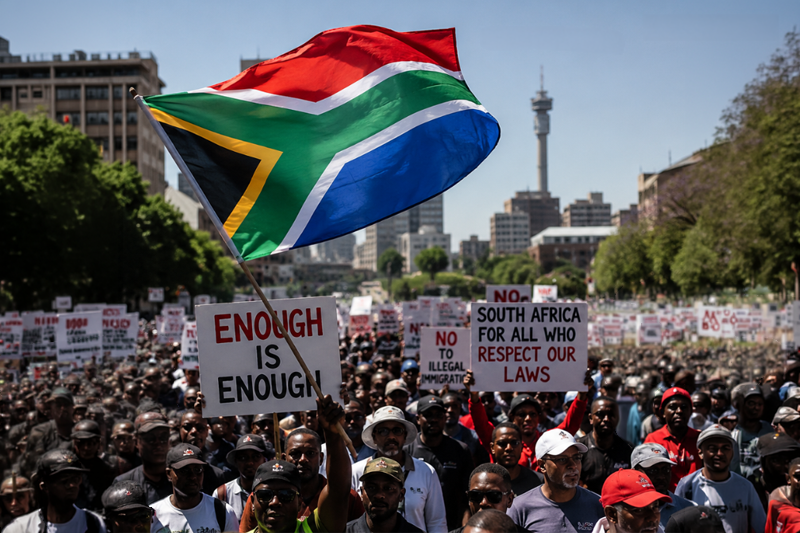
AI Generated Image

Johannesburg, 06 July 2026

Senior ministers have tied South Africa’s xenophobic violence to unnamed foreign actors and the government’s ICJ case against Israel, with no evidence offered. The SAZF calls it deflection from a failure at home, and asks for proof or a retraction.

A cabinet minister has spent the week pointing abroad. The people being driven from their homes and their shops need her to look closer to home.

This weekend the Sunday Times reported, in its own words, that Justice Minister Mmamoloko Kubayi implies Israeli involvement in the recent anti-immigrant marches. The framing is the newspaper’s, not ours. The minister offered no evidence of any foreign role, because there is none to offer.

She is not the first. Asked in May who was behind a hostile narrative against South Africa, International Relations Minister Ronald Lamola gestured at “state and non-state actors” and linked them to the ICJ case the ANC-led government brought against Israel. Two senior ministers, the same insinuation, and between them not a shred of proof.

This matters, and not because Israel needs defending from a claim this thin. It matters because when senior members of Cabinet reach for a hidden foreign hand rather than account for a failure at home, and do so months before a local election in which immigration is being openly exploited, it stops looking like a careless remark and starts looking like a habit.

And Minister Kubayi knows better, because she has said better. She has acknowledged that there were elements of political campaigning in the mobilisation, and that some saw an opportunity to advance local government ambitions. She has invoked the pattern of the July 2021 unrest. Every one of those drivers is domestic. None of them is foreign.

The record is not in dispute. Xenophobic violence has scarred this country for the better part of two decades, long before South Africa took Israel to the ICJ. Dozens were killed in the attacks of 2008. More died in 2015 and again in 2019. The African Commission on Human and Peoples’ Rights recognises xenophobia as a longstanding South African problem. It cannot have been caused by a court case filed fifteen years after the first bodies were counted.

While the minister searches for a foreign author, the victims are real and close at hand. Nigerians, Zimbabweans, Ethiopians and Mozambicans have been barricaded in their homes, their livelihoods destroyed. Nigeria, Ghana and Mozambique have formally protested to Pretoria. A conspiracy theory protects none of them.

The SAZF puts one question to the minister, and it admits of only honest answers. If she has evidence of foreign state involvement in these marches, she must produce it or place it before the appropriate authorities. If she does not, she must withdraw the insinuation. There is no third path that is truthful.

Deflection is the easy road, and South Africa’s leaders have walked it before. It buys the government time. It buys the victims nothing.
Sign Up For Our Newsletter

Get the latest news, events, and initiatives. Be part of a community that stands for Israel and strengthens ties between South Africa and the Jewish homeland.

Name(Required)
Email(Required)
Privacy(Required)
  • AI Generated Image

    Blaming Israel will not protect a single migrant

    {acf_job_title}

    Johannesburg, 06 July 2026

    Senior ministers have tied South Africa’s xenophobic violence to unnamed foreign actors and the government’s ICJ case against Israel, with no evidence offered. The SAZF calls it deflection from a failure at home, and asks for proof or a retraction.

    A cabinet minister has spent the week pointing abroad. The people being driven from their homes and their shops need her to look closer to home.

    This weekend the Sunday Times reported, in its own words, that Justice Minister Mmamoloko Kubayi implies Israeli involvement in the recent anti-immigrant marches. The framing is the newspaper’s, not ours. The minister offered no evidence of any foreign role, because there is none to offer.

    She is not the first. Asked in May who was behind a hostile narrative against South Africa, International Relations Minister Ronald Lamola gestured at “state and non-state actors” and linked them to the ICJ case the ANC-led government brought against Israel. Two senior ministers, the same insinuation, and between them not a shred of proof.

    This matters, and not because Israel needs defending from a claim this thin. It matters because when senior members of Cabinet reach for a hidden foreign hand rather than account for a failure at home, and do so months before a local election in which immigration is being openly exploited, it stops looking like a careless remark and starts looking like a habit.

    And Minister Kubayi knows better, because she has said better. She has acknowledged that there were elements of political campaigning in the mobilisation, and that some saw an opportunity to advance local government ambitions. She has invoked the pattern of the July 2021 unrest. Every one of those drivers is domestic. None of them is foreign.

    The record is not in dispute. Xenophobic violence has scarred this country for the better part of two decades, long before South Africa took Israel to the ICJ. Dozens were killed in the attacks of 2008. More died in 2015 and again in 2019. The African Commission on Human and Peoples’ Rights recognises xenophobia as a longstanding South African problem. It cannot have been caused by a court case filed fifteen years after the first bodies were counted.

    While the minister searches for a foreign author, the victims are real and close at hand. Nigerians, Zimbabweans, Ethiopians and Mozambicans have been barricaded in their homes, their livelihoods destroyed. Nigeria, Ghana and Mozambique have formally protested to Pretoria. A conspiracy theory protects none of them.

    The SAZF puts one question to the minister, and it admits of only honest answers. If she has evidence of foreign state involvement in these marches, she must produce it or place it before the appropriate authorities. If she does not, she must withdraw the insinuation. There is no third path that is truthful.

    Deflection is the easy road, and South Africa’s leaders have walked it before. It buys the government time. It buys the victims nothing.